
Insurance: useful or unnecessary?
Mobile phone insurance: yes or no? Here you will learn the basic principle behind every insurance policy – the group bears the individual's risk – and apply two rules of thumb that help you distinguish useful from unnecessary offers. Finally, you will sort ten insurance products into five categories ranging from ‘compulsory’ to ‘examine critically’.
Das lernst du hier
- I can explain the basic principle of insurance: the group bears the individual's risk, and the premium is the price paid for this.
- I can apply the two rules of thumb: insure against risks that threaten your financial security and cover small losses yourself – and do not mix insurance with saving.
- I can classify insurance into the categories compulsory, highly advisable, depends on the situation, usually unnecessary and examine critically.
Liechtensteiner Lehrplan (LiLe): WAH.5.2 (Die Schülerinnen und Schüler können soziale, rechtliche und ökonomische Aspekte im Alltag und im Zusammenleben recherchieren.), WAH.3.3 (Die Schülerinnen und Schüler können kriterien- und situationsorientierte Konsumentscheidungen finden.)
The ball, the window – and the big question
While playing football in your neighbourhood, your ball lands in your neighbour's conservatory – broken window, damage: a few hundred francs. Annoying, but manageable. Now imagine that you hit a pedestrian while cycling, she has a bad fall and cannot work for months. Suddenly, you face hundreds of thousands of francs in compensation – money that neither you nor your family simply has.
This is exactly why insurance exists. Its basic principle is remarkably simple: Lots of people regularly pay a contribution into a shared fund – and the few who suffer a loss receive compensation from it. In other words, the group bears the individual's risk.
Here is an example calculation: in one town, 1000 people each own a bicycle worth CHF 800. Experience shows that about 10 bicycles are stolen each year – a total loss of CHF 8000. If all 1000 people share this loss, each person pays CHF 8 per year. The insurer's costs and profit must be added, so the premium might be CHF 12. This is the price you pay to transfer your risk: you pay a small, predictable amount rather than a large amount that could threaten your financial security on the rare occasion that something happens.
This also shows you that insurance is not a savings account. Normally, over the years you pay in more than you receive – in return, you are protected if something happens to you. Whether this is worthwhile depends on the risk. There are two rules of thumb to help you decide.
Two rules of thumb for navigating the insurance jungle
Rule of thumb 1: Insure against risks that threaten your financial security – cover small losses yourself.
A broken mobile phone screen will not ruin you: it is a small, manageable loss. By contrast, a liability claim worth millions could burden you and your family for the rest of your lives – a risk that threatens your financial security. Because every premium also includes the insurer's administrative costs and profit, the rule is: anyone who insures every little thing will lose money in the long run. Anyone who does not insure against the big risk is risking everything. So insure what you cannot afford to cover yourself.
Rule of thumb 2: Do not mix insurance with saving.
Some products – a typical example is endowment life insurance – combine insurance cover and a savings plan in one contract. That sounds convenient, but is usually expensive and inflexible: the costs are difficult to understand, and anyone who withdraws early often loses money. The rule of thumb keeps the two clearly separate: buy protection with pure insurance and save separately – that way you remain flexible and can see exactly what each one costs you.
Here is another term you will encounter everywhere: the excess (also called the deductible). This is the share of a loss that you pay yourself before the insurer pays. It has a sensible purpose: people who contribute towards the cost remain careful and do not report every minor loss – this keeps premiums low for everyone.
Video: How does insurance work?
This educational video (4:48) by the Swiss education provider Eduty explains the basic principle of insurance. As you watch, focus on two key questions: (1) How does the video describe the shared fund – who pays into it, and who receives money from it? (2) What does ‘moral hazard’ mean – and how does an excess help to address this problem?
Transkript anzeigen
Eduty's educational video (4:48 minutes) introduces the topic of insurance. It presents three types of insurance and explains how insurance basically works: many policyholders regularly pay a premium into a shared fund, which the insurer uses to cover an individual's loss – the group bears the individual's risk. The video then discusses the problem of ‘moral hazard’: people who are insured might behave more recklessly because they no longer bear the loss themselves. As a countermeasure, it explains the excess (deductible), under which policyholders cover part of the loss themselves – this encourages them to remain careful and keeps premiums lower.
Five categories: from ‘compulsory’ to ‘examine critically’
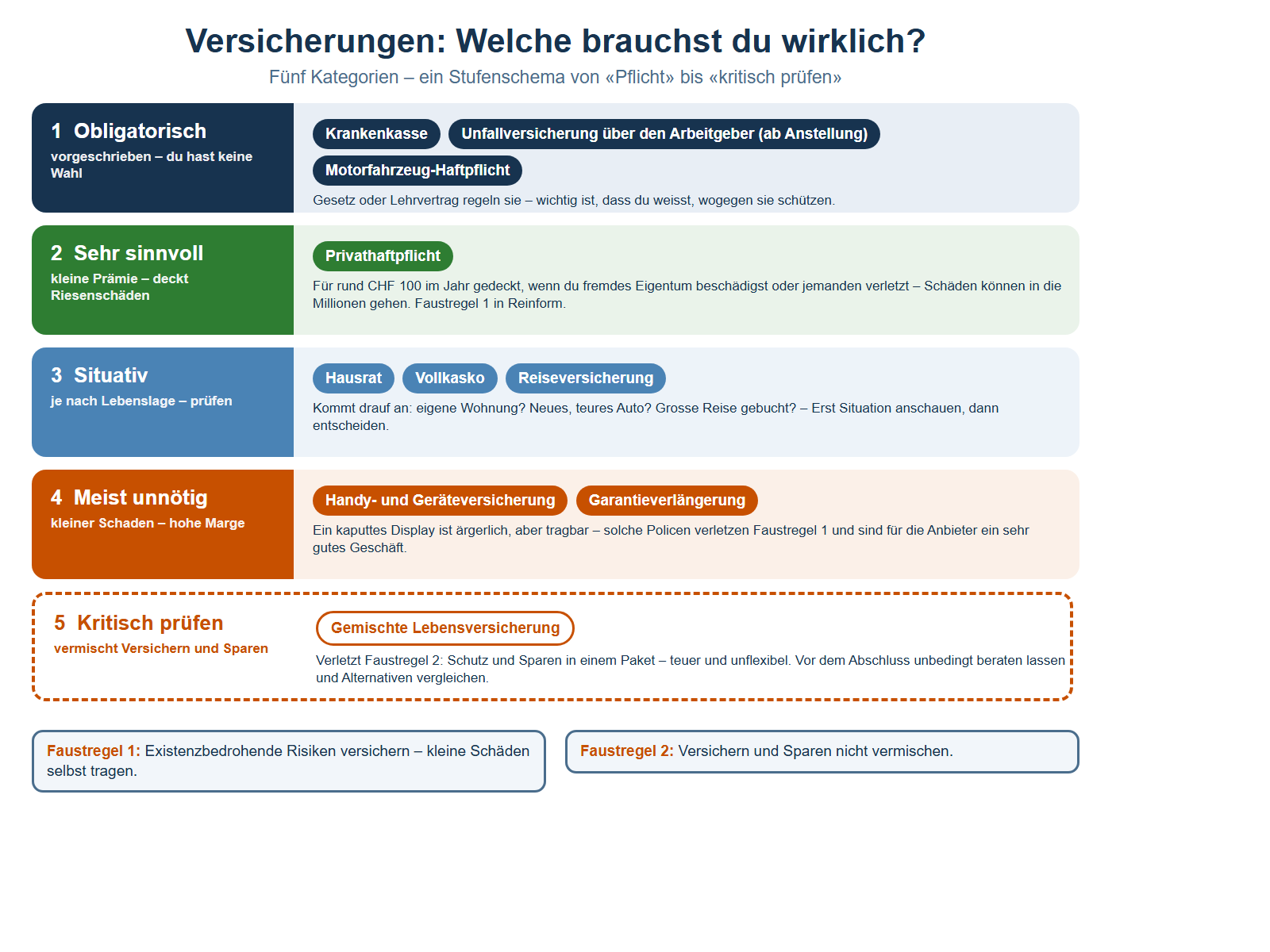
Using the two rules of thumb, you can place almost any insurance offer into one of five categories:
- Compulsory – you have no choice here because the law or your employment contract requires it: health insurance (basic insurance – compulsory for everyone who lives or works in Liechtenstein), accident insurance through your employer (you are automatically insured from the first day of your employment – important when you start your apprenticeship!) and motor vehicle liability insurance (no car or moped may be driven on the road without it). One special feature in Liechtenstein is that sickness allowance insurance is also compulsory for employees aged 15 and over – it replaces part of their wages during a longer illness.
- Highly advisable – personal liability insurance: for around a hundred francs a year, it covers losses that you cause to other people – and these can run into the millions. Rule of thumb 1 in its purest form: a small premium protects you against a risk that could threaten your financial security.
- Depends on the situation – useful depending on your circumstances: household contents insurance (worthwhile when you have your own home), comprehensive car insurance (for a new, expensive car – hardly worthwhile for an old second-hand one), travel insurance (perhaps for an expensive long-haul trip, but not for a weekend in Ticino).
- Usually unnecessary – mobile phone and device insurance, extended warranties: the potential loss is small and manageable, while the premium is high in comparison – policies (the name for insurance contracts) like these are very good business for providers, but rarely for you.
- Examine critically – endowment life insurance: it breaks rule of thumb 2 because it mixes insurance and saving. Always seek independent advice and compare alternatives before taking out a policy.
Important: categories 3 to 5 do not mean ‘always wrong’ – they mean: think first, then sign. You are about to practise precisely this classification.
The tiered model of insurance categories
Quiz: Understanding insurance
Frage 1 von 8Show that you understand the principle of insurance and the rules of thumb. You can repeat the quiz as often as you like – your best result counts.
What does the statement ‘The group bears the individual's risk’ mean?
Insert the terms: The principle of insurance
Drag the appropriate terms into the gaps (on a mobile: tap the word first, then the gap). Caution: Three words in the selection do not fit anywhere.
Tippe zuerst ein Wort an und dann die Lücke, in die es gehört. Antippen einer gefüllten Lücke legt das Wort zurück.
Insurance is based on a simple principle: lots of people regularly pay a into a shared fund. If a member suffers a , it is paid from the fund – the therefore bears the individual's risk. Rule of thumb 1 says: insure against risks that your financial security – you are better off covering small losses . A prime example is : for a small premium, it covers losses that can run into the . Mobile phone and device insurance, by contrast, is usually , because a broken screen is annoying but manageable. Rule of thumb 2 warns: do not mix with saving – life insurance breaks this very rule.
Type in the terms: Insured in everyday life
There is no word bank this time – type in the missing terms yourself. Capitalisation does not matter.
From the first day of your apprenticeship, you have compulsory accident insurance through your . Basic is compulsory in Liechtenstein for everyone who lives or works here. Anyone who registers a car or moped must have motor vehicle . The regular price you pay for insurance cover is called the . And if you cover part of a loss yourself, this share is called the .
Match them: Ten products, five categories
Assign each insurance product to the appropriate category: compulsory, highly advisable, depends on the situation, usually unnecessary or examine critically. Some categories occur more than once. For each product, consider: what do the two rules of thumb say?
Tippe zuerst ein Wort an und dann die Lücke, in die es gehört. Antippen einer gefüllten Lücke legt das Wort zurück.
Basic health insurance. Accident insurance through the company providing the apprenticeship. Motor vehicle liability insurance for a moped. Personal liability insurance. Household contents insurance for your first home of your own. Comprehensive insurance for a brand-new car. Travel insurance for a booked long-haul trip. Screen insurance for a new mobile phone. An extended warranty for a games console. Endowment life insurance (protection and a savings plan in one).
Going further: The insurance check
Erkläre in eigenen Worten – so merkst du am besten, was du schon verstanden hast.
Deine Antworten werden auf diesem Gerät gespeichert und gehen mit deinem nächsten Fortschritts-Report an die Lehrperson.
Your friend has bought a mobile phone for CHF 900. The sales assistant offers her device insurance: CHF 8 per month, with a CHF 100 excess for any claim. Advise your friend: calculate what the insurance costs over the typical period of use of two to three years, and apply rule of thumb 1.
Tipp anzeigen
First add up the premiums: CHF 8 × 24 months and × 36 months. Compare this with the cost of a typical repair (replacing a screen often costs CHF 200 to 350) – and do not forget the excess. Then ask the key question from rule of thumb 1: would the loss threaten her financial security?
Carry out the insurance check at home: ask your parents or another adult which insurance policies they have. Choose three and assign them to the five categories from this module. Is there an insurance policy that you would discuss together?
Tipp anzeigen
Typical candidates: health insurance, personal liability insurance, household contents insurance, car insurance (liability? partial cover? comprehensive cover?), travel insurance, legal expenses insurance and life insurance. Also ask: why was this insurance taken out – and when was it last reviewed?
Explain the principle of insurance to someone you know using the bicycle example from the module (1000 bicycles, 10 thefts per year) – and then answer their follow-up question: ‘And why is the premium higher than the CHF 8 that the calculation says would be needed?’
Tipp anzeigen
Build your explanation in three steps: the shared fund, who receives money from it, and why it is worthwhile for everyone. For the follow-up question: what else does an insurer have to pay for besides the losses – and what is its purpose as a business?