
Natural hazards in the Alps
Avalanches, floods, debris flows and rock avalanches: using real Swiss case studies such as the avalanche winter of 1999, Bondo in 2017 and Brienz in 2023, you will learn how natural hazards in the Alps arise, how Switzerland protects itself against them and why climate change makes them worse.
Das lernst du hier
- I can explain how avalanches, floods, debris flows and rock avalanches occur.
- I can use Swiss case studies (the avalanche winter of 1999, Bondo in 2017, Brienz in 2023) to describe how natural events affect people and the environment.
- I can distinguish between protective measures such as engineered structures, protection forests, warning systems and hazard maps, and assess their benefits.
- I can explain why climate change intensifies natural hazards in the Alps.
Lehrplan 21: RZG.1.3.b (Die Schülerinnen und Schüler können sich über aktuelle Naturereignisse informieren und deren Ursachen erklären.), RZG.1.3.c (Die Schülerinnen und Schüler können die Auswirkungen von Naturereignissen auf Lebenssituationen von Menschen und auf die Umwelt benennen und einschätzen.), RZG.1.2.c (Die Schülerinnen und Schüler können sich über den Klimawandel informieren, Ursachen erläutern und Auswirkungen des Klimawandels auf verschiedene Regionen der Welt, insbesondere die Schweiz, einschätzen.)
When the mountain moves
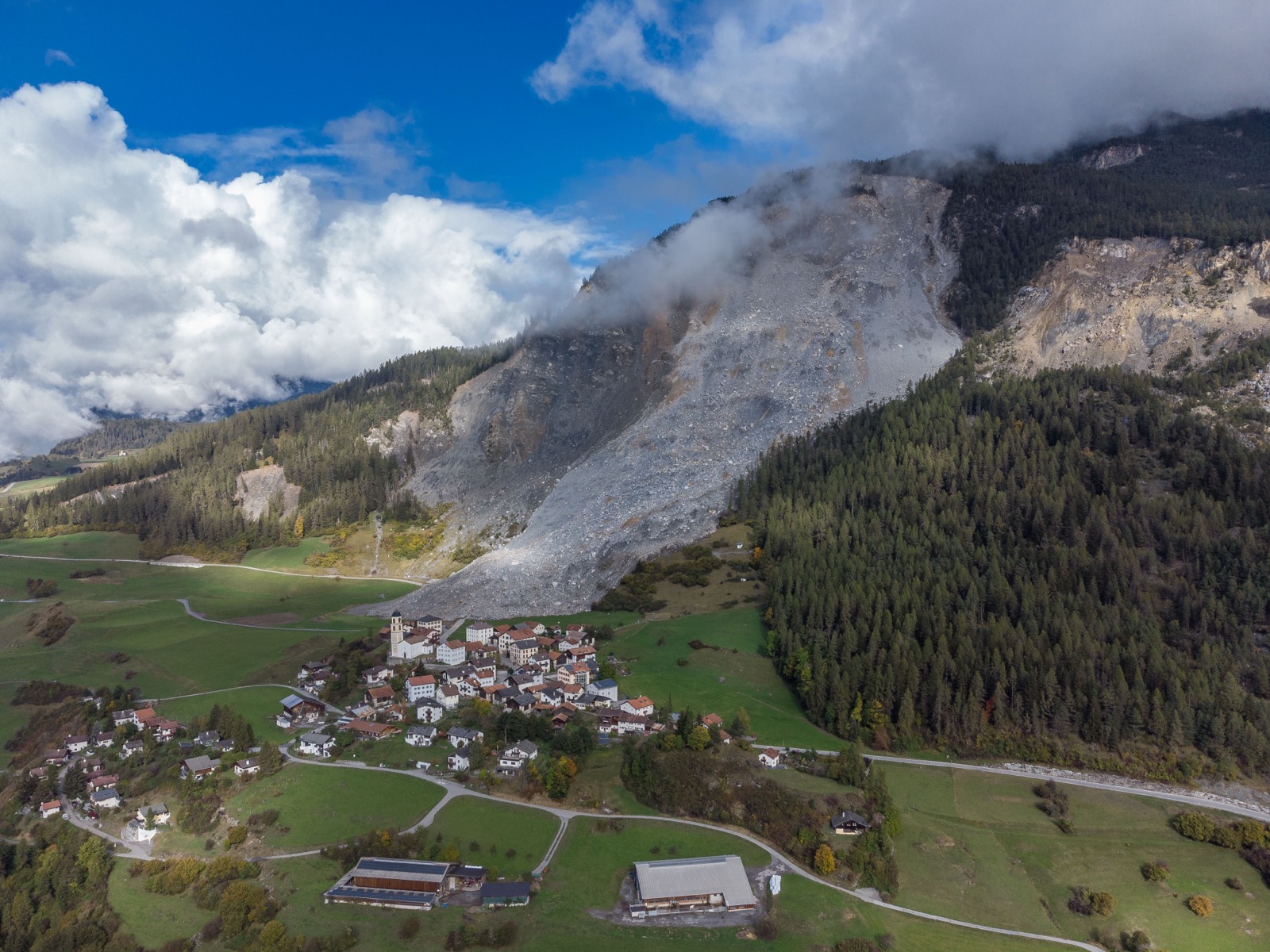
Imagine the authorities knock on your door: "You have to leave your village – the mountain above you could collapse." This is exactly what happened in May 2023 to the roughly 90 residents of Brienz/Brinzauls in Graubünden. Around five weeks later, during the night leading into 16 June 2023, around 1.2 million cubic metres of rock and debris really did thunder down into the valley – and came to a halt just a few metres from the village.
Living in the Alps means living with natural hazards. The main ones are:
- Avalanches – masses of snow that break away from a slope
- Floods and debris flows – water, mud and rock debris that flood valleys
- Rockfalls and rock avalanches – rock that breaks away from cliff faces
In this module, you will find out how these hazards arise, how Switzerland protects itself with engineered structures, protection forests, warning systems and hazard maps – and why climate change makes all of this worse.
Video: How can we protect ourselves against avalanches?
Watch the explainer video from SRF Kids (about 4 minutes). Pay particular attention to the following: which **three protective measures** against avalanches are shown? And where on the slope does each one act?
Transkript anzeigen
This explainer video from the SRF series "Clip und klar!" shows why avalanches are a major hazard in the Swiss Alps and how people protect themselves. It presents three key protective measures: avalanche barriers on slopes that hold the snow in place, protection forests that act as natural barriers, and spatial planning with hazard zones where building is not allowed. The video uses examples from Switzerland and is aligned with Lehrplan 21.
Avalanches: the white danger
Most dangerous avalanches are slab avalanches: an entire layer of snow breaks away at once and races down into the valley. They mainly occur on slopes steeper than about 30 degrees – especially after heavy snowfall or when wind redistributes the snow.
Case study: the avalanche winter of 1999: In February 1999, several metres of snow fell in the higher parts of the Swiss Alps within just a few weeks. Around 1200 avalanches caused damage, claiming 17 lives in buildings and on transport routes. Evolène in Wallis was hit hardest: twelve people died there on 21 February 1999. Total damage amounted to around 600 million francs.
This is how Switzerland protects itself today:
- Warning systems: The WSL-Institut für Schnee- und Lawinenforschung SLF in Davos publishes an avalanche bulletin once or twice a day in winter (at 17:00, with an update at 08:00 if needed). It uses the European avalanche danger scale with five levels – from level 1 (low) to level 5 (very high).
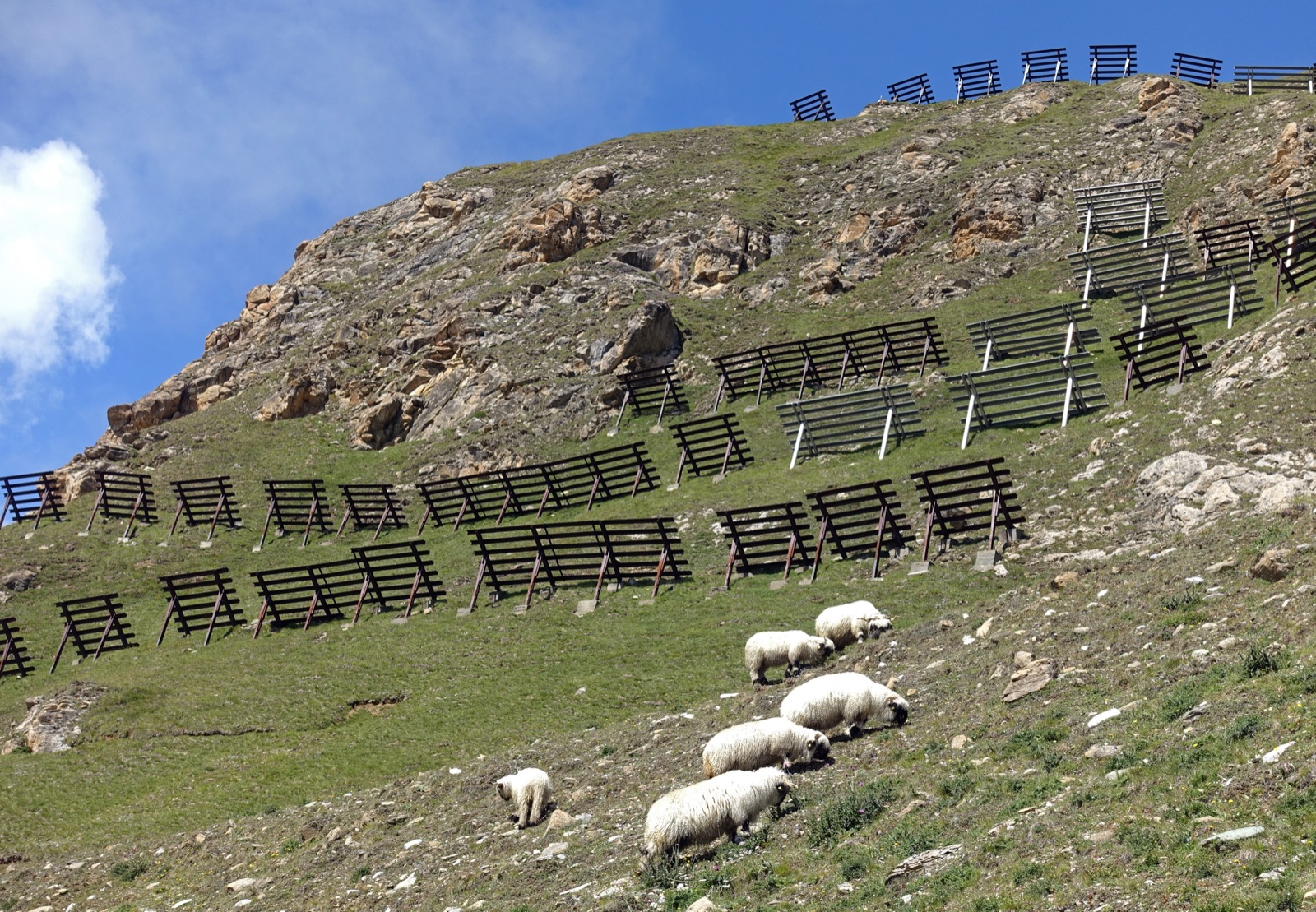
- Engineered structures: Steel supporting structures in the avalanche release area hold the snow on the slope before an avalanche can even start.
- Protection forests: Trees stabilise the snow cover. Around 42 per cent of Switzerland's forest area serves as protection forest against natural hazards – the cheapest "barrier" of all.
- Spatial planning: Building is not allowed in high-hazard zones in the first place.
- Emergency measures: When danger is imminent, roads and ski areas are closed or avalanches are triggered using controlled explosions.
Protection starts on the slope
When water and rock debris thunder down into the valley
Flooding occurs when heavy rain, long periods of rain or snowmelt supply more water than rivers and soils can absorb. Straightened rivers and floodplains that have been built on make the problem worse, because the water has nowhere else to go. The floods of August 2005 were Switzerland's costliest single natural event to date: six people died and damage amounted to around 3 billion francs. Today, flood protection therefore relies not only on embankments but also on river restoration, which gives rivers more space again.
A particularly dangerous form occurs in steep mountain streams: a debris flow – a fast-flowing mixture of water, mud and rock debris that shoots down the stream bed into the valley like liquid concrete.
Case study: Bondo (GR), 23 August 2017: Around 3 million cubic metres of rock broke away from Piz Cengalo (3369 m above sea level). The rock avalanche fell onto a glacier, swept up ice and water, and triggered huge debris flows that travelled through Val Bondasca into the village of Bondo. Eight hikers who were walking in the valley lost their lives. There were no deaths in the village itself: an automatic alarm system gave a timely warning, the residents were evacuated, and a retention basin held back some of the material. Even so, houses were destroyed and roads were buried – Bondo shows that warning systems can save lives but cannot always prevent damage.
A narrow escape for the village
Video: Living with rock avalanches – the case of Brienz
The main topic of this episode of SRF Kids News (about 11 minutes) is the rock avalanche in Brienz. Look out for the following: how is the slope **monitored**? And what do evacuations mean for the residents' everyday lives?
Transkript anzeigen
The main topic of this Kids News episode is the rock avalanche in Brienz (GR): following the major rock avalanche of 2023, another section of rock has broken away. The video explains how rock avalanches occur and shows what the ongoing danger, constant monitoring of the slope and evacuations mean for the residents of this village in Graubünden. A second, shorter report at the end of the episode covers a different everyday topic (shopping for presents).
Climate change makes hazards worse – and how Switzerland responds
Brienz stands on a slope that has been slowly sliding down into the valley for centuries. After the residents returned in summer 2023, the village had to be evacuated again in November 2024 – its future is uncertain. A drainage tunnel deep inside the mountain is intended to drain water from the slope and slow its movement.
Climate change makes many natural hazards in the Alps worse:
- Permafrost thaws: Permafrost is permanently frozen ground. In Switzerland, it mainly occurs higher than about 2500 m above sea level and covers about 5 per cent of the country's area. The ice in cracks in the rock acts like cement, holding the rock together. When it thaws, rock faces become unstable – thawing permafrost played a role in the rock avalanche at Bondo.
- More heavy precipitation: Warmer air can hold more moisture. Heavy rainfall – and therefore floods and debris flows – becomes more likely.
- Glaciers melt: They expose loose rock debris and destabilise slopes that were previously supported by ice.
Switzerland cannot prevent such events – but it can reduce the risks. Hazard maps are a key tool: experts map the areas in each municipality where avalanches, floods or landslides pose a threat.
| Zone | Hazard level | Meaning |
|---|---|---|
| Red | high | New homes must not be built |
| Blue | medium | Building is allowed only under certain conditions, e.g. reinforced walls |
| Yellow | low | Indicates a possible hazard |
Other measures include monitoring (sensors, radar), warning systems, engineered structures and protection forests. Sometimes the only option left is to evacuate in time – as in Bondo and Brienz.
Tasks
Type your answer to each task directly into the text field – it will become part of your report, which you can share with your teacher. Use the hints if you get stuck.
Erkläre in eigenen Worten – so merkst du am besten, was du schon verstanden hast.
Deine Antworten werden auf diesem Gerät gespeichert und gehen mit deinem nächsten Fortschritts-Report an die Lehrperson.
Search online for the hazard map for your municipality (e.g. through your canton's geoportal or map.geo.admin.ch). Which natural hazards are mapped in your area? Are there red, blue or yellow zones near your route to school or where you live?
Tipp anzeigen
Search for "Gefahrenkarte" (hazard map) plus the name of your canton. In the Mittelland, you will mainly find flood hazard zones; in mountain areas, there are also avalanche and landslide hazard zones.
Compare the three natural hazards avalanche, debris flow and rock avalanche: for each one, write a short paragraph covering What happens?, Typical trigger, Swiss case study and A suitable protective measure.
Tipp anzeigen
You will find the case studies in the text blocks: the avalanche winter of 1999 (Evolène), Bondo in 2017 and Brienz in 2023.
Discuss: Brienz has been evacuated several times, and expensive measures such as the drainage tunnel are intended to save the village. Should a lot of money be spent on protecting a village facing such danger – or would it be better to abandon it and relocate the residents? Write down two arguments for each side, then give your own opinion with reasons.
Tipp anzeigen
Think about: the cost to the public, protecting human lives, the residents' attachment to their home and their feelings, and the outlook as climate change progresses.
Learning by teaching: Create your own quiz question about one of the three case studies (the avalanche winter of 1999, Bondo in 2017 or Brienz in 2023) – with three answer options, exactly one of which is correct. Write down the question and the three options, then explain why the correct answer is right.
Tipp anzeigen
Good distractors (incorrect answers) are almost right: for example, a similar year or a measure that applies to a different natural hazard.
Test your knowledge of natural hazards in the Alps
Frage 1 von 6What is a debris flow?