
The industrialisation of Switzerland
From the spinning wheel in a farmhouse to the factory, from the Spanisch-Brötli-Bahn to the Gotthardtunnel: you will discover why Switzerland industrialised so early, how people's lives changed – and how the Factory Act of 1877 responded to child labour and the social question.
Das lernst du hier
- I can explain why industrialisation began earlier in Switzerland than in most countries in continental Europe (water power, capital from trade, no guilds in the countryside).
- I can describe the shift from working at home to working in factories in the textile industry and explain its effects on individual people.
- I can explain the importance of railway building – from the Spanisch-Brötli-Bahn in 1847 to the Gotthardbahn in 1882 – for Switzerland's economic development.
- I can explain how the social question led to the Federal Factory Act of 1877 and the emergence of the labour movement.
Lehrplan 21: RZG.5.2.a (Die Schülerinnen und Schüler können die Entwicklung der Erwerbssektoren am Beispiel der Schweiz aufzeigen und erläutern (z.B. Veränderungen der Anzahl Bauernhöfe in der Schulgemeinde, Entwicklung der Anzahl Beschäftigten in den drei Erwerbssektoren im 19. und 20. Jahrhundert in der Schweiz).), RZG.6.2.b (Die Schülerinnen und Schüler können zu einem Aspekt der Industrialisierung verschiedene Informationen finden und miteinander vergleichen (z.B. ein Bild, eine Textquelle, ein Erlebnisbericht zur Dampfmaschine).), RZG.5.2.c (Die Schülerinnen und Schüler können Auswirkungen von wirtschaftlichen Veränderungen auf einzelne Menschen erklären (z.B. Technisierung, Inflation, Hochkonjunktur, Energieknappheit).)
A country changes – radically
Take a quick look around you: machines wove your T-shirt, your train runs (almost) to the minute, and your mid-morning snack comes from the supermarket. Around 200 years ago, none of this could be taken for granted. Most families in Switzerland lived off their own plot of land – and earned a little extra by spinning and weaving cotton in the main room of their home.
Then, within a few decades, almost everything changed: factories with smoking chimneys sprang up amid farmland, the first railway steamed from Zürich to Baden, and children spent twelve hours a day at noisy machines. Small Switzerland – with no coal deposits and no access to the sea – was one of the earliest countries in Europe to industrialise after Great Britain.
In this module, you will find out:
- Why industrialisation began so early in Switzerland
- How home-based work gave way to factory work
- What the railway had to do with Switzerland's economic rise
- What price men, women and children working in factories paid – and how the country began to change with the Factory Act of 1877
Video: Why Switzerland industrialised so early
As you watch, focus on three things: what role did water power from rivers and streams, capital from trading families, and the absence of guild rules in the countryside play? And think about this: what did the shift from the spinning wheel at home to the machine in the factory mean for a farming family?
Transkript anzeigen
In around seven minutes, Swiss economic journalist Philipp Löpfe explains why Switzerland was one of the earliest countries in continental Europe to industrialise, following Great Britain's lead. The focus is on the textile industry: the shift from spinning and weaving in rural homes to mechanised factory production. The video shows Switzerland's main advantages as a location for industry: water power from its many rivers and streams, available capital from trade, and the absence of restrictive guild regulations in the countryside.
From the farmhouse to the factory
Before factories existed, textile production operated through the putting-out system: a merchant brought raw cotton to farming families in the countryside. Women, men and children spun and wove in the main room of their home, alongside their farm work. The merchant collected the yarn and cloth and sold them on. This home-based work was widespread in areas such as the Zürcher Oberland and eastern Switzerland.
The big turning point came around 1800: spinning machines had been invented in England that worked much faster and more cheaply than any spinning wheel. In 1801, the first English-style spinning machines were installed in St. Gallen, and in 1802 the Spinnerei Hard on the Töss near Winterthur began operating – one of the first mechanised spinning mills on the European continent. For many people who spun at home, this meant that their manual work no longer paid. Many eventually looked for work in the very factories that had competed with them.
Why Switzerland in particular? Three advantages were crucial:
- Water power: Switzerland has no coal, but countless rivers and streams. Water wheels and later turbines drove the machines – which is why many old factories stand right by the water.
- Capital: Swiss trading and merchant families had built up fortunes through the textile trade and could invest in expensive machines and factory buildings.
- No guilds in the countryside: In the towns, guilds strictly controlled the crafts. These rules did not apply in the countryside – there, people were allowed to build factories and produce goods freely. There were also many people who already had experience of textile production from working at home.
This made the textile industry by far Switzerland's most important export industry in the 19th century.
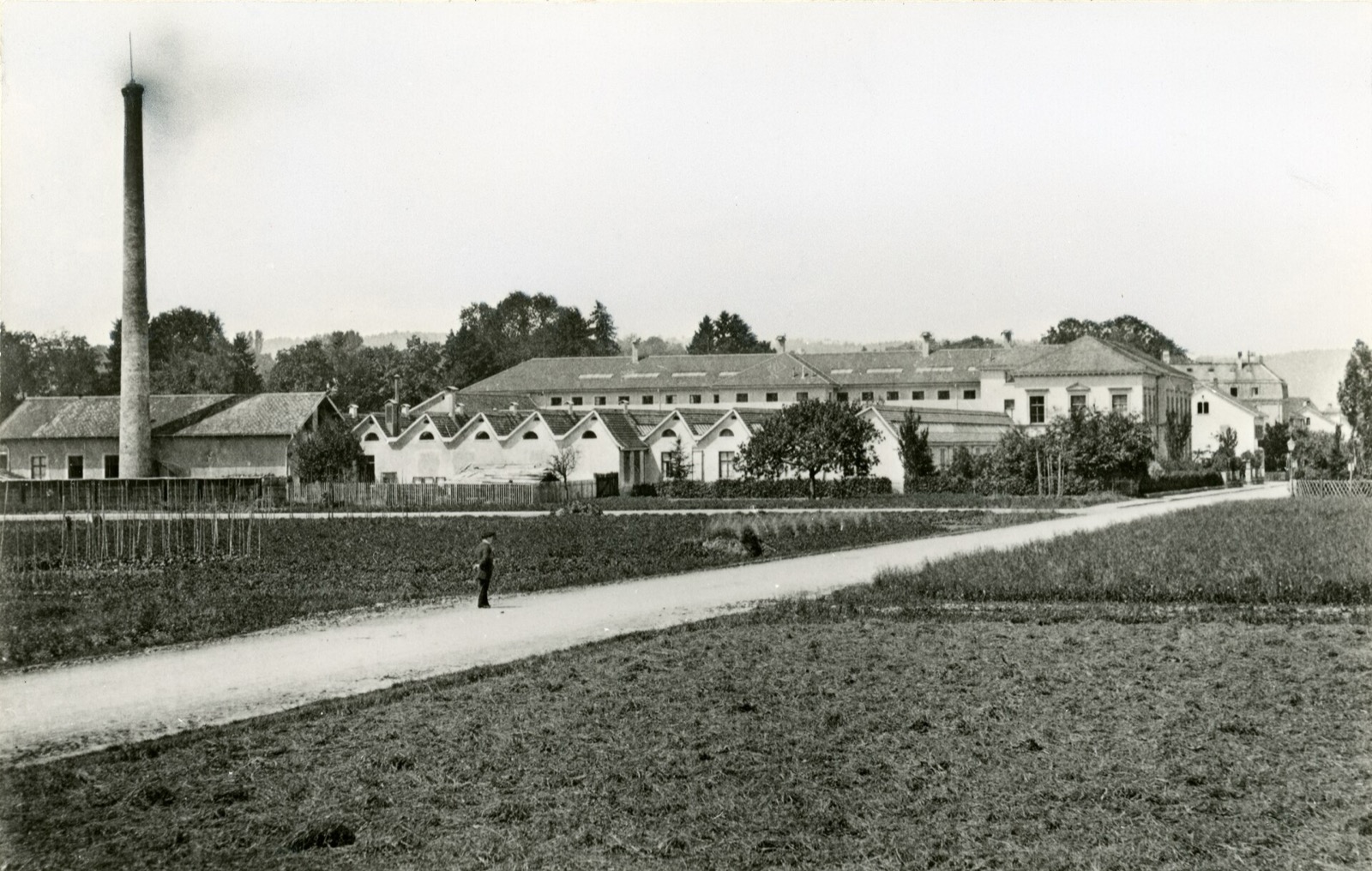
A factory amid farmland
The railway brings a second boost
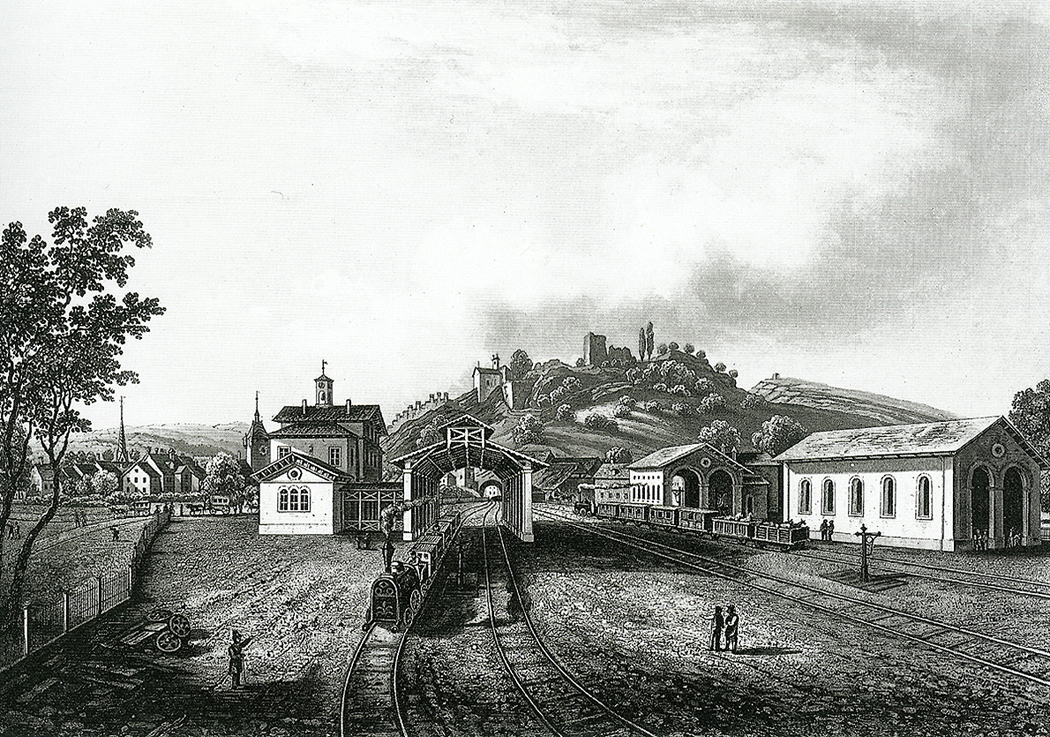
On 9 August 1847, the moment arrived: the first railway line running entirely on Swiss soil began operating. It covered around 23 kilometres from Zürich to Baden – a journey of about 45 minutes instead of several hours on foot or by carriage. According to legend, it got its name because wealthy people in Zürich had fresh "Spanisch Brötli" – a popular puff pastry from Baden – delivered by train: the Spanisch-Brötli-Bahn. (A French railway line from Elsass had, in fact, already reached Basel in 1844.)
From the 1850s onwards, a real railway boom followed, fundamentally changing the economy:
- A strong machinery and metal industry developed to supply rails, bridges and locomotives.
- To finance the expensive railway projects, Zürich politician and entrepreneur Alfred Escher founded the Schweizerische Kreditanstalt in 1856 – banks and insurance companies grew alongside the railway.
- Goods, people and news travelled faster than ever before.
The most ambitious project was the Gotthardtunnel: from 1872, thousands of workers – most of them from Italy – dug the tunnel, around 15 kilometres long, through the mountain. Conditions were brutal: heat, dust, flooding and accidents cost around 200 workers their lives. When tunnel workers in Göschenen went on strike for better conditions in 1875, the strike was violently suppressed – four workers were killed in a hail of bullets. The building contractor Louis Favre did not live to see his work completed either: he died during an inspection in the tunnel in 1879. The Gotthardbahn opened in 1882. At the time, the tunnel was the longest in the world and made Switzerland an important transit country between northern and southern Europe.
Baden: the end of the line
Video: Factory work, child labour and the social question
This video gives an overview of the Industrial Revolution in Europe. Look out for the following: under what conditions did people work in factories? Why did towns and cities grow so quickly – and what is meant by the "social question"? As you watch, think about which aspects also apply to Switzerland.
Transkript anzeigen
In just under seven minutes, Mirko Drotschmann (MrWissen2go Geschichte) explains how the Industrial Revolution spread from England to the European continent and transformed the economy, society and people's living conditions. The video covers factory work with harsh working conditions and child labour, the rapid growth of towns and cities (urbanisation), the resulting social question and the beginnings of the labour movement. It provides the European context for developments in Switzerland, such as the Factory Act of 1877.
The social question – and Switzerland's response
Progress had a darker side. In factories, working days of twelve hours or more were common – six days a week, amid noise, dust and dangerous machines. Children, too, worked in spinning and weaving mills, often at the expense of their schooling: they were cheap labour. At the same time, more and more families moved from the countryside to growing industrial towns and cities (urbanisation), where they often lived in cramped, unhealthy housing. How should society deal with this new poverty and insecurity? This debate was known as the social question.
Switzerland responded earlier than most countries:
- In 1864, the Landsgemeinde, the citizens' assembly of the canton of Glarus, passed a factory act that was the first in Europe to limit working hours for adult workers too (a twelve-hour day). Glarus had already banned factory work for children under twelve in 1856.
- In 1877, Swiss voters narrowly approved the Federal Factory Act. It limited factory work to eleven hours per working day, banned factory work for children under 14, protected women who had recently given birth and made factory owners liable for accidents. State factory inspectors checked that the rules were followed. This made Switzerland one of the international pioneers of worker protection.
At the same time, workers began to organise themselves: the Schweizerische Gewerkschaftsbund was founded in 1880, and the Sozialdemokratische Partei der Schweiz in 1888. The world of work changed fundamentally: within just a few generations, Switzerland had gone from an agricultural country to an industrial society – more and more people earned their living in factories, workshops and offices rather than on farms.
Tasks
Now it's your turn! Type your answers directly into the text fields – they will be sent to your teacher. The hints you can expand will help you get started.
Erkläre in eigenen Worten – so merkst du am besten, was du schon verstanden hast.
Deine Antworten werden auf diesem Gerät gespeichert und gehen mit deinem nächsten Fortschritts-Report an die Lehrperson.
Compare home-based work in the putting-out system with work in a factory. Give at least two advantages and two disadvantages of each form of work – from the perspective of a working family around 1850.
Tipp anzeigen
Think about: working hours and pace (who decides them?), how much you earn and how reliable that income is, how the work fits in with farming and family life, and dangers at work.
Look closely at the photograph of the weaving mill in Winterthur around 1880. Write down two observations that tell you something about how Switzerland was changing, and two questions that the picture alone cannot answer.
Tipp anzeigen
Start by describing only what you can see: buildings, a chimney, fields, people. Then think about this: what does it mean that this factory stands amid farmland?
Imagine you are a 12-year-old child working in a spinning mill in 1877. Write a short diary entry (about 10 sentences) about a working day – then a second entry from 1878, after the Federal Factory Act has come into force.
Tipp anzeigen
First entry: an early start, noise, dust, tiredness, hardly any time for school. Second entry: you are now 13 – what exactly does the ban on factory work for children under 14 change for you, and perhaps for your family's income too?
Learning by teaching: Create your own quiz question about this module with three answer options (one correct, two incorrect). Write down the question and the answers, and explain in your own words why the correct answer is right. If you like, then ask a classmate your question.
Tipp anzeigen
Good distractors (incorrect answers) are almost right – for example, a year that is only slightly off, or an event that really happened but does not fit the question.
Test your knowledge of Switzerland's industrialisation
Frage 1 von 6Which places did the Spanisch-Brötli-Bahn connect when it opened in 1847 as the first railway line running entirely on Swiss soil?