
Watch or see? (extended)
«Watch or see?» – an extension module (Level B1) in the English learning path «Cate's Sound Lab», an optional extra for everyone who wants to go deeper: You learn the difference between watch, see and look at – from music videos to live concerts – and use the past simple and past perfect confidently in your own sentences and in a longer text.
Das lernst du hier
- I can use watch, see and look at correctly.
- I can build past simple and past perfect forms in my own sentences.
- I can complete a longer story and decide from the context which past event happened first.
Liechtensteiner Lehrplan (LiLe): FS1E.5.B.1 (Die Schülerinnen und Schüler verfügen über einen angemessenen Wortschatz, um sich mündlich und schriftlich zu äussern.), FS1E.5.D.1 (Die Schülerinnen und Schüler können grammatische Strukturen in Texten erkennen und für das Verständnis nutzen sowie beim Sprechen und Schreiben anwenden.)
Welcome to the extended module «Watch or see?»
This is the extended module of the unit «Cate's Sound Lab». It is made for learners who want a bigger challenge – if you are in the extended track, this module is for you; everybody else can use it as extra practice.
You will:
- learn when to use watch, see and look at – three verbs for your eyes, just like listen and hear were for your ears,
- build past simple and past perfect forms yourself, without answer options,
- complete a longer story about an unforgettable concert.
Take your time, and go back to Module 2 whenever you need the grammar rules again.
Part 1: watch, see or look at?
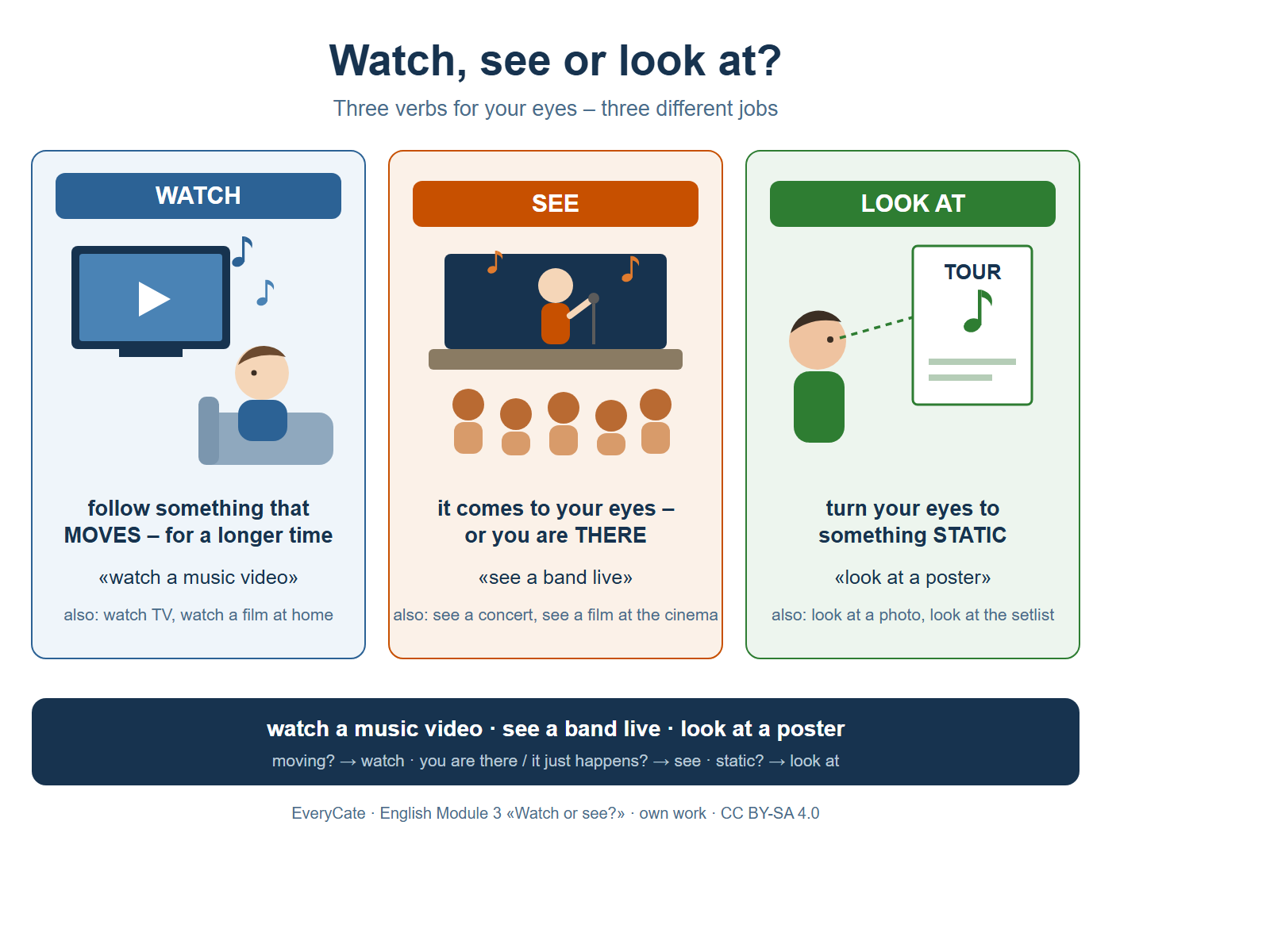
All three verbs are about your eyes – but they do different jobs.
watch = follow something that moves, for a longer time, with attention.
- We watched the band's new music video three times in a row.
- Thousands of fans watched the drummer's solo on the big screens.
see = something comes to your eyes (you don't plan it) – or you attend an event: you see a film at the cinema, a concert, a band live.
- I saw your sister in the crowd, but she didn't see me.
- Next summer we're going to see our favourite band live in Zurich.
look at = turn your eyes to something static – a photo, a poster, a setlist – usually for a short moment.
- Look at this old tour poster – it's from 1998!
- She looked at the setlist and smiled.
In short: moving + longer → watch · it just comes to your eyes, or you are in the audience → see · static + you turn your eyes to it → look at.
One warning for music fans: you usually watch a music video, but you see a band live or see a concert (= you are there). The picture below shows all three.
Three verbs for your eyes
Exercise 1: watch, see or look at?
Frage 1 von 6Choose the correct option for each gap. Think about the three jobs: moving, coming to your eyes / being there, or static.
Quiet, please! We are ___ the new music video right now.
Exercise 2: The right verb in the right tense
Drag the correct form into each gap (on a phone: tap the form first, then the gap): watch, see or look at – in the tense that fits the sentence. Careful: three forms in the list are wrong forms – they fit nowhere.
Tippe zuerst ein Wort an und dann die Lücke, in die es gehört. Antippen einer gefüllten Lücke legt das Wort zurück.
Every Sunday I old concert films on my laptop for hours. I my old schoolmate in the crowd yesterday, but a second later she was gone. Please the stage design in this photo – isn't it amazing? Before last night, I the band live only once, at a tiny festival. By the time the interview started, half a million people the new video. During the guitar solo, everyone the guitarist's hands – nobody wanted to miss a single move. After the concert, we all the photos on Lea's phone, one by one.
Part 2: Quick reminder – past simple and past perfect
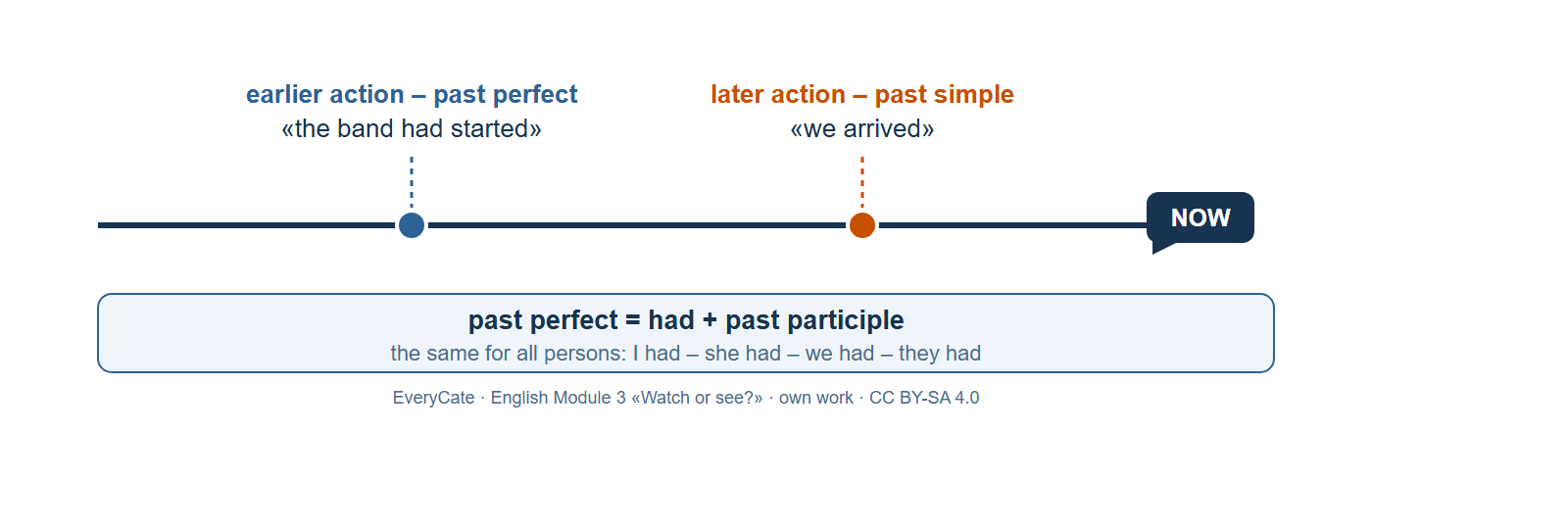
You know this from Module 2: with two past actions, the past perfect (had + past participle) marks the one that happened first; the later action takes the past simple. Signal words: before, after, already, by the time, when.
When we arrived, the band had already started.
If you want the full explanation and the big timeline, go back to Module 2 «Listen or hear?». From here on, you build the forms yourself – no answer options any more.
The timeline in one line
Exercise 3: Build the form
Complete each sentence with the verb in brackets. Use the past simple or the past perfect – decide which action came first. Careful: sometimes the gap is the later action!
By the time we reached the stadium, the show (begin). When we met at six, Mia (buy) our tickets already, so we walked straight in. We (go) home by bus after the final song. I recognised the melody at once, because I (hear) it many times before. By the time the encore (begin), some fans had already left the hall. The band (see) the fans' banners and smiled. Before the doors (open), fans had waited in the rain for hours. It was the best show I (see) in my whole life.
Exercise 4: The concert I will never forget
Read the whole story first. Then complete it: put each verb in brackets into the past simple or the past perfect. The context tells you which event happened earlier.
Two years ago, my favourite band finally (come) to Switzerland. I (want) to see them live for years, so my aunt bought us tickets as a birthday surprise. When we arrived at the stadium, hundreds of fans (take) their places already. The band (play) in our country twice before, but I (miss) both shows because I was too young. At nine o'clock, the lights (go) out, and the crowd screamed. The singer (begin) with a quiet song that she (write) as a teenager. By the end of the night, I (sing) so loudly that I could hardly speak – but I was the happiest person in the stadium.
Exercise 5.1: Build the sentence
New task type! Put the pieces in the right order and build a correct sentence – drag them into the row, or tap them one after the other. Careful: one piece is wrong and stays out.
Tippe die Bausteine in der richtigen Reihenfolge an – sie werden hinten angehängt. Antippen eines platzierten Bausteins legt ihn zurück; mit den Pfeilen sortierst du um.
- Hier entsteht dein Satz …
Exercise 5.2: Build the sentence
Build the next sentence. One piece is wrong and stays out – watch the tense.
Tippe die Bausteine in der richtigen Reihenfolge an – sie werden hinten angehängt. Antippen eines platzierten Bausteins legt ihn zurück; mit den Pfeilen sortierst du um.
- Hier entsteht dein Satz …
Exercise 5.3: Build the sentence – a look back at Module 2
Build the sentence. One piece is wrong and stays out – think of the two verbs for your ears.
Tippe die Bausteine in der richtigen Reihenfolge an – sie werden hinten angehängt. Antippen eines platzierten Bausteins legt ihn zurück; mit den Pfeilen sortierst du um.
- Hier entsteht dein Satz …
Exercise 5.4: Build the question
And one question to finish. Two pieces are wrong and stay out this time.
Tippe die Bausteine in der richtigen Reihenfolge an – sie werden hinten angehängt. Antippen eines platzierten Bausteins legt ihn zurück; mit den Pfeilen sortierst du um.
- Hier entsteht dein Satz …
Final quiz: eyes, ears and two past tenses
Frage 1 von 6Six questions from the whole module – vocabulary, grammar, and one look back at Module 2.
You were at a big show last Saturday and want to tell everyone: «I ___ my favourite band live!»