
Listen or hear?
«Listen or hear?» – part of the English learning path «Cate's Sound Lab»: You learn the difference between listen (to) and hear, practise the right form in sentences from the world of songs and radio – and use the past simple and past perfect to tell what happened first on a concert night. Level A2–B1.
Das lernst du hier
- I can use listen (to) and hear correctly.
- I can form and use the past perfect for the earlier of two past actions.
- I can decide which of two past actions happened first and choose the right tense.
Liechtensteiner Lehrplan (LiLe): FS1E.5.B.1 (Die Schülerinnen und Schüler verfügen über einen angemessenen Wortschatz, um sich mündlich und schriftlich zu äussern.), FS1E.5.D.1 (Die Schülerinnen und Schüler können grammatische Strukturen in Texten erkennen und für das Verständnis nutzen sowie beim Sprechen und Schreiben anwenden.)
Welcome back to «Cate's Sound Lab»!
In Module 1 you talked about your music taste. In this second module you will practise two things that English learners often mix up:
- Part 1 – two verbs for your ears: When do you use listen (to), and when do you use hear?
- Part 2 – two past tenses: How do you show that one thing in the past happened before another thing? This is the job of the past perfect.
All examples come from the world of songs, concerts and radio. Read the two short explanations carefully – then the exercises will feel much easier.
Part 1: listen or hear – what is the difference?
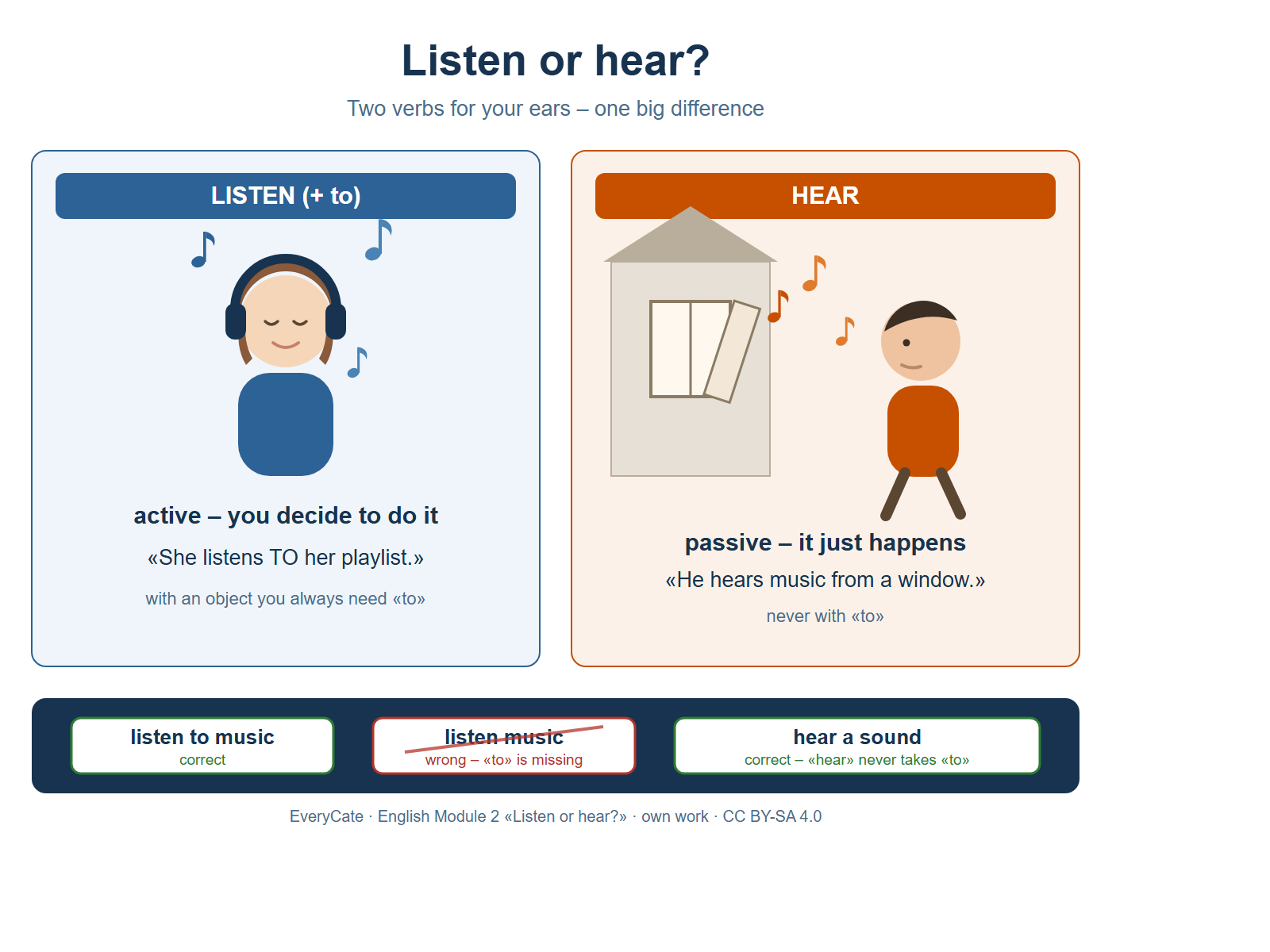
listen = active. You decide to do it, and you give the music your attention.
- Cate puts on her headphones and listens to her new playlist.
- Please listen carefully – the melody changes after the chorus.
hear = passive. It just happens. The sound comes to your ears, and you did not plan it.
- On my way to school I sometimes hear music from an open window.
- Did you hear that? Somebody is playing the drums!
The little word to: Before an object, listen always needs to: you listen to music, you listen to the radio. Hear never takes to: you simply hear a sound. And when there is no object at all, listen stands alone: «Quiet, please – now listen!»
Look at the picture: the girl has chosen her music and gives it her attention. The boy did not choose anything – the song simply reaches his ears.
Listen or hear?
Exercise 1: listen, listen to or hear?
Frage 1 von 5Choose the correct word or words for each gap. Think: active or passive? And do you need to?
Every morning I turn on the radio and ___ my favourite programme while I eat breakfast.
Exercise 2: Type the correct form
Type the correct form of listen (to) or hear into each gap. Pay attention to the time in each sentence – some are about the past. And don't forget to where it is needed.
Every evening I my favourite playlist before I go to sleep. Our neighbours are loud. Even with my door closed, I their music through the wall. Yesterday, while I was doing my homework, I suddenly a great new song on the radio. Last night we sat down and the whole album from start to finish. My grandad turns on the radio and his favourite station every morning. The music in this café is very quiet – can you it at all?
Part 2: past simple or past perfect – which happened first?
Read this sentence from a concert evening:
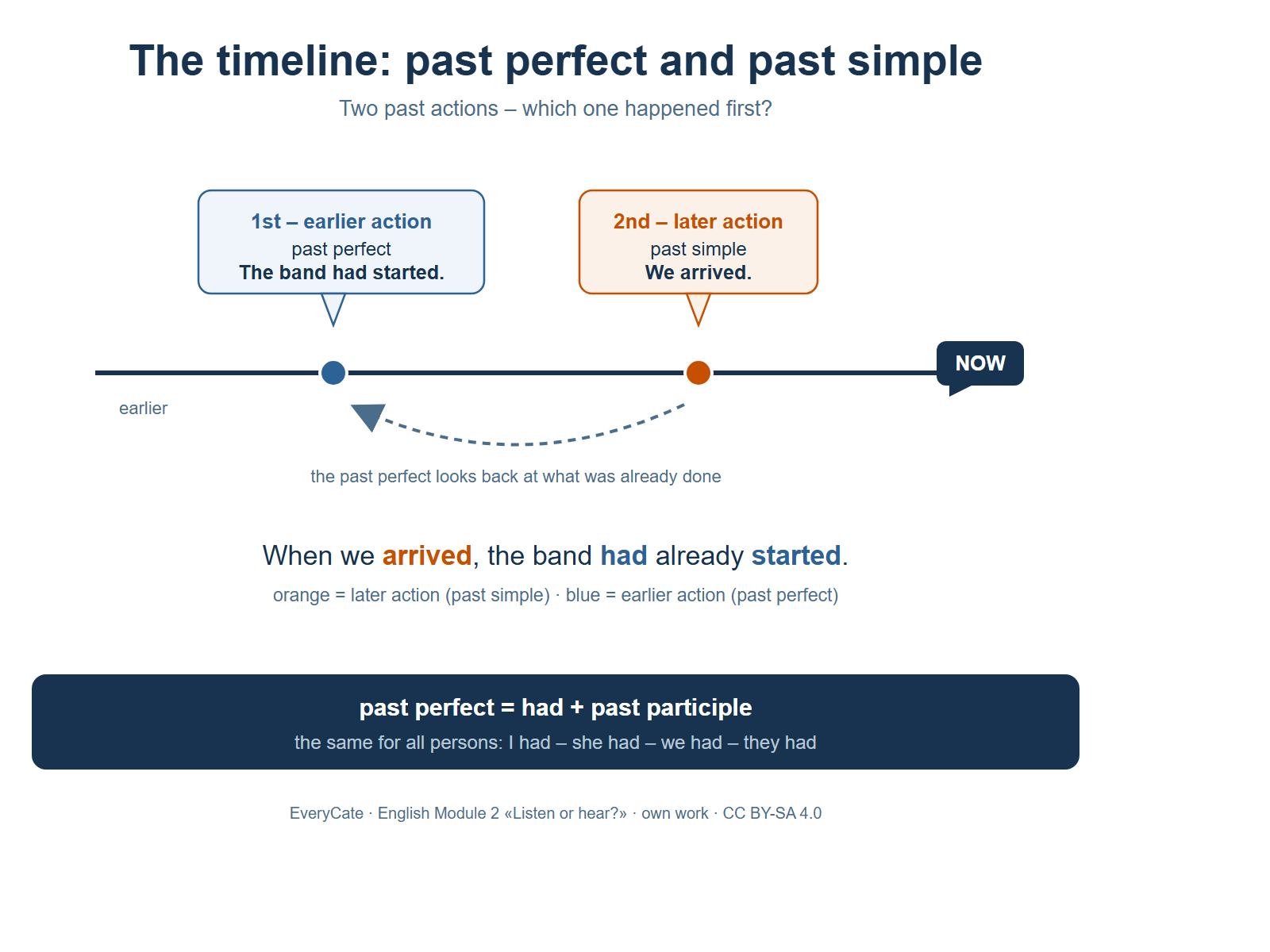
When we arrived, the band had already started.
Two things happened in the past – but not at the same time. First the band started, then we arrived. English shows this order with two tenses:
- past perfect for the earlier action: the band had started
- past simple for the later action: we arrived
The form is easy: had + past participle – and it stays the same for I, you, he, she, it, we and they. I had heard – she had heard – they had heard.
Signal words that often appear in these sentences: before, after, already, by the time, when.
Six past participles you will need – learn them by heart:
| verb | past simple | past participle |
|---|---|---|
| go | went | gone |
| see | saw | seen |
| hear | heard | heard |
| sing | sang | sung |
| buy | bought | bought |
| begin | began | begun |
The timeline picture shows the concert example: both actions lie in the past, but one of them lies further back.
The timeline: past perfect and past simple
Exercise 3: Which action came first?
Frage 1 von 5Five questions in two formats: sometimes you decide which action happened first, sometimes you choose the correct form for a gap.
«When Lena arrived at the hall, the concert had already begun.» – What happened first?
Exercise 4: A concert evening
Drag the verb forms into the story (on a phone: tap the form first, then the gap). Watch out: three forms in the list are wrong forms – they fit nowhere.
Tippe zuerst ein Wort an und dann die Lücke, in die es gehört. Antippen einer gefüllten Lücke legt das Wort zurück.
Last Friday evening, Mia and I to a rock concert in Vaduz. Mia the tickets two months before, so we had great seats. When we at the hall, the support band – we could hear the last song through the doors. By the time we found our seats, the support band its show, and the stage was empty. After the first songs of the main band, I that I knew every melody: I the album so many times at home! It was a fantastic night.
Final quiz: listen, hear and the past perfect
Frage 1 von 5Five questions from both parts of the module. You can go back and read the explanations again at any time.
You are on the bus. Someone's phone plays loud music – you don't want it, but you ___ it anyway.