
Cate's Sound Lab: Talking about music
«Cate's Sound Lab» – the start of your English learning path all about music: You learn basic vocabulary for genres and instruments, pick up adjectives for describing music, read a short text about earworms, watch a TED-Ed video about them – and write your own «music profile» in English. Level A2–B1.
Das lernst du hier
- I can talk and write about music and my music taste in simple English.
- I know basic words for music genres, instruments and concerts.
- I can describe music with adjectives like catchy, relaxing or powerful.
- I can understand a short English text and a short English video about earworms.
Liechtensteiner Lehrplan (LiLe): FS1E.1.A.1 (Die Schülerinnen und Schüler können verschiedenartige Hörtexte und Gespräche verstehen (Sachtexte, ästhetische Texte, Texte im Schulalltag, Gespräche im Kontakt mit Englisch sprechenden Personen).), FS1E.2.A.1 (Die Schülerinnen und Schüler können verschiedenartige Texte lesen und verstehen (Sachtexte, ästhetische Texte, Texte im Schulalltag, Texte im Kontakt mit Englisch sprechenden Personen).), FS1E.4.A.1 (Die Schülerinnen und Schüler können verschiedene Texte verfassen (Sachtexte, ästhetische Texte, Texte im Schulalltag, im schriftlichen Kontakt mit Englisch sprechenden Personen).), FS1E.5.B.1 (Die Schülerinnen und Schüler verfügen über einen angemessenen Wortschatz, um sich mündlich und schriftlich zu äussern.)
Welcome to «Cate's Sound Lab»!
Music is everywhere: in your headphones, in games, in shops – and sometimes it plays on and on in your head. This is the first module of the unit «Cate's Sound Lab», and it is all about music.
In this module you will:
- learn words for genres, instruments and concerts,
- learn adjectives to describe music (catchy, cheerful, relaxing, powerful, annoying, unforgettable),
- read a short text and watch a short video about earworms – songs that get stuck in your head,
- write a few sentences about your own music taste.
All tasks are in English. Read slowly, use the picture and the word banks – and don't worry about small mistakes. Have fun!
Warm-up: Music trivia
Frage 1 von 4Four easy questions about music before we start. Just try – this is a warm-up, not a test!
Which of these instruments is a string instrument?
Reading: Why do songs get stuck in your head?
You hear a song in the morning. Hours later, in class, it is still playing in your head – again and again. English has a funny name for this: an earworm.
Earworms are very common. Studies show that more than 90 per cent of people get an earworm at least once a week. Usually it is not the whole song that repeats, but only a small part of it – often the catchiest bit.
Why does this happen? Scientists are still not sure. But they know when songs get stuck: mostly when we have heard them often, and when our brain is not busy – for example, when we wait for the bus or tidy our room.
Catchy songs have a lot in common. They are often fast, they have a simple melody that is easy to sing, and they repeat their main idea many times. Think of your favourite pop song: how often do you hear the chorus?
And what can you do about an earworm? Research gives us three tips: listen to the whole song to the end, chew some gum, or give your brain a little job – for example, a puzzle.
Check your reading
Frage 1 von 5Five questions about the text. Read the text again if you are not sure – that is allowed!
What is the text mainly about?
Vocabulary A: Genres, instruments and concert words
Drag the words into the gaps (on a phone: tap the word first, then the gap). Every word is used exactly once.
Tippe zuerst ein Wort an und dann die Lücke, in die es gehört. Antippen einer gefüllten Lücke legt das Wort zurück.
A song is usually modern, short and easy to sing – perfect for the radio charts. Mozart and Beethoven wrote music more than 200 years ago. The drummer hits the with two sticks. A looks like a piano, but it is electronic and you can carry it. Twenty singers sing together in our school . The band walks onto the , and the concert begins. After the last song, the claps and shouts «One more song!». Everybody dances to the beat, because the of the song is strong and steady. You can hum the of a song without using any words. I read the on my phone, because I want to understand what the singer says.
Vocabulary B: Words to describe music
Type the missing adjective into each gap. The only help is the first letter of the word, given in brackets. Capital or small letters – both are fine.
We sang this song every day at our school camp. For me, it is (u…) – I will remember it all my life. In the evening I listen to quiet piano music, because it is so (r…) – it makes me calm. I heard this song only once, but it is so (c…) that I can't stop humming the melody. My little brother plays the same three notes again and again – it is so (a…)! You can feel the drums in your whole body – the sound of this rock band is really (p…). This song is not sad at all – it is bright and (c…) like a sunny day.
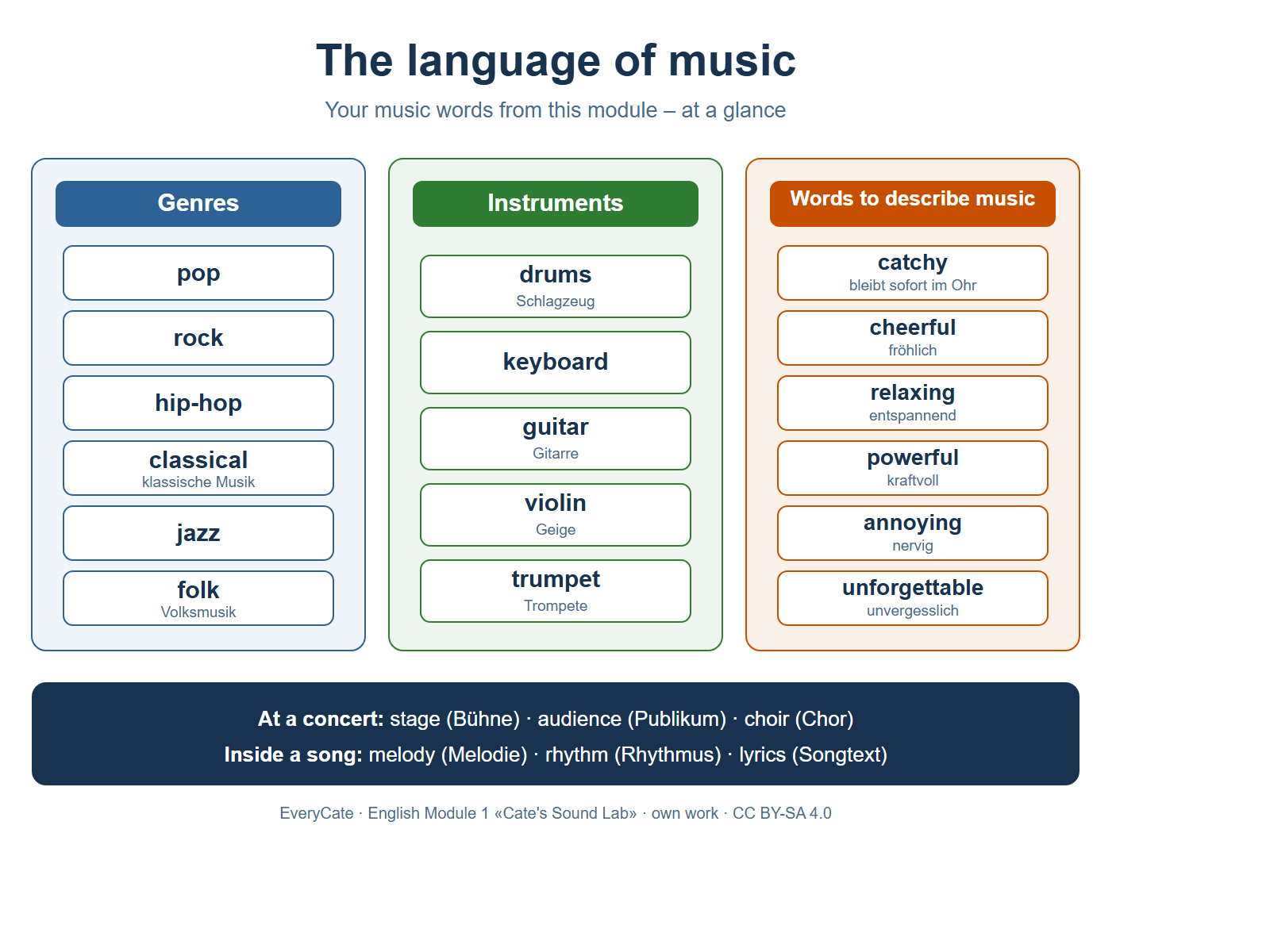
The language of music
Video: Earworms – songs that get stuck in your head
Watch this short animated video (4:45) by TED-Ed. It is in English – you can turn on English subtitles with the CC button, and you can pause as often as you like. Watch out for three things: How many people get earworms? Which songs get stuck? And why does your brain want to play a tune to the end once it has started?
Transkript anzeigen
Short summary of the video: Over 90 per cent of people get an earworm at least once a week, and about a quarter of people have one several times a day. Earworms often start during tasks that do not need much attention, like waiting for a traffic light. An earworm is «involuntary»: the song fragment comes into your head without an invitation – like an unwanted house guest – usually as a melody (a tune), and it can repeat for minutes or hours. Songs get stuck mainly when we have heard them recently and repeatedly. But earworms are not a modern problem: in 1876, one year before the phonograph was invented, the writer Mark Twain wrote a story about a little rhyme that took over a whole town. One theory says that a tune works like a habit, like tying your shoe: when we know a song, we always «hear forward» and expect the next note, so the brain wants to play the tune to its natural stopping point. In the end, scientists still do not know exactly why earworms exist – but studying them could teach us a lot about the human brain.
Check your listening
Frage 1 von 3Three questions about the video. You can watch it again before you answer.
What does the video say about how common earworms are?
Focus: My music profile
Now it is your turn! In this last task you write about your own music taste.
Erkläre in eigenen Worten – so merkst du am besten, was du schon verstanden hast.
Deine Antworten werden auf diesem Gerät gespeichert und gehen mit deinem nächsten Fortschritts-Report an die Lehrperson.
Write your music profile: 3–4 sentences in English about you and your music. Answer these questions in your text:
- What is your favourite genre or band?
- When and where do you listen to music?
- Which song do you love at the moment – and why?
When you are done, check your text with this list:
- I named my favourite genre.
- I used at least two adjectives from this module (catchy, cheerful, relaxing, powerful, annoying, unforgettable …).
- I wrote when and where I listen to music.
- I named one song and said why I love it.
- I wrote 3–4 complete sentences.
Tipp anzeigen
You can start like this: «My favourite genre is …, because it is …» – «I usually listen to music when …» – «At the moment I love the song … because …». The picture «The language of music» above has all the words you need.
Final quiz: Show what you know
Frage 1 von 5Five questions about the whole module: the text, the words and the video. Good luck!
The words of a song are called the …