
EU and EEA: Europe as a single market
Why does your online order from Germany arrive without customs paperwork – and why does Liechtenstein use Swiss francs even though it belongs to the European single market? Here you will learn the basic idea behind European integration – peace through economic interdependence – understand the single market's four freedoms through everyday examples, distinguish between the EU and the EEA, and describe Liechtenstein's special dual role in the EEA and the Swiss customs area.
Das lernst du hier
- I can explain the basic idea behind European integration: after 1945, close economic interdependence was intended to prevent further wars in Europe.
- I can name the single market's four freedoms – free movement of goods, services, people and capital – and give an everyday example of each.
- I can distinguish between the EU and the EEA: the EEA extends the single market to Iceland, Liechtenstein and Norway – Liechtenstein is an EEA member, but not an EU member.
- I can describe Liechtenstein's dual role – as an EEA member and also part of a shared customs and currency area with Switzerland – and explain why this is an advantage as a business location.
Liechtensteiner Lehrplan (LiLe): WAH.2.1 (Die Schülerinnen und Schüler können Prinzipien der Marktwirtschaft aufzeigen.), WAH.3.1 (Die Schülerinnen und Schüler können Einflüsse auf die Gestaltung des Konsumalltages erkennen.), RZG.8.3 (Die Schülerinnen und Schüler können die Positionierung Liechtensteins in Europa und der Welt wahrnehmen und beurteilen.)
Never again war – using the economy as a tool
You order trainers from a German online shop, your cousin studies in Graz, and people who commute across the border every morning work at the business next door. All perfectly normal – today. Just over eighty years ago, this was unthinkable: between 1914 and 1945, the countries of Europe devastated one another in two world wars.
After 1945, a major question therefore arose: how can we stop neighbours ever shooting at one another again? The answer Europe found was unusual: not just peace treaties, but economic interdependence. The idea was that if factories, raw materials and markets were linked across borders, war would always damage a country's own economy too. Countries that trade closely with one another simply have too much to lose.
The first step was a clever choice: in 1952, six countries – including former wartime enemies France and Germany – pooled their coal and steel industries. These were precisely the industries needed for tanks and guns at the time! Countries that produce together and inspect one another's books cannot secretly build up arms against each other. Over the decades, this beginning grew into today's European Union (EU) with 27 member states. The member states adopt shared rules through joint institutions such as the European Parliament and the European Commission – for this module, you only need to know those names.
The results of the basic idea can be stated plainly: there has been no war between the member states of this union since it was founded. Step by step, the idea of peace also developed into something that still shapes your everyday life: a huge single market.
Who belongs to what?
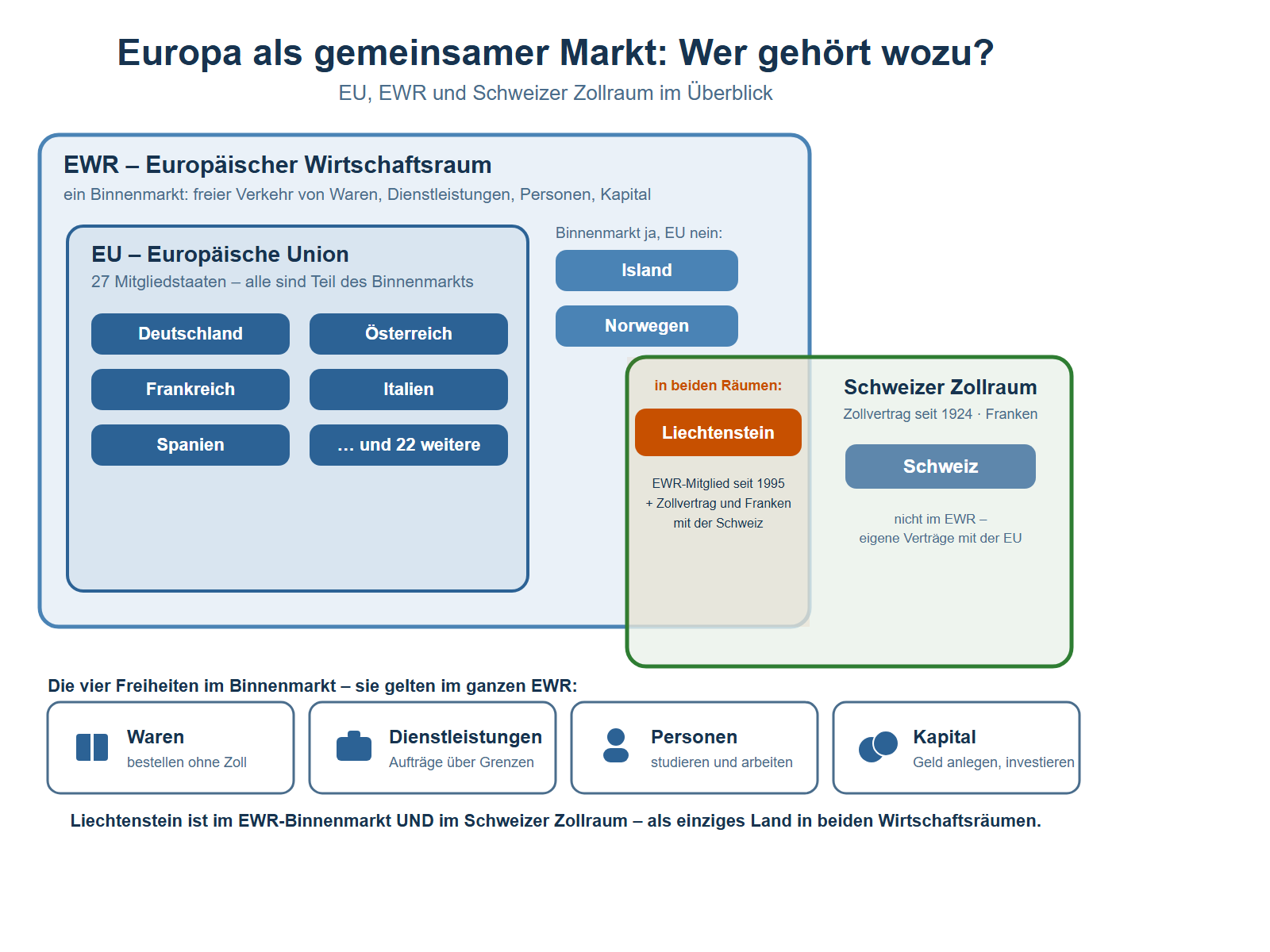
The single market: four freedoms for your everyday life
At the heart of economic integration is the single market, also called the internal market. ‘Internal’ means ‘inside’: the participating countries treat one another economically as though they were one country – trading across a border should feel like trading within a country. To make this work, the single market guarantees four freedoms:
- Free movement of goods: Products can cross borders without customs duties or extra paperwork. Your online order for 89 CHF from Germany therefore arrives like a domestic order – without an extra customs bill.
- Free movement of services: Work that does not involve selling goods can also be sold across borders. A graphic designer from Vaduz designs the website of a café in Wien; a painting company takes on jobs in a neighbouring country.
- Free movement of people: People can study, start an apprenticeship or work in another member country – without special permit barriers. A semester abroad or an internship in Berlin? That is exactly what this freedom is for.
- Free movement of capital: Money can flow across borders. A saver buys shares in a Norwegian company; a business builds a factory in Portugal.
A memory aid for two freedoms that are often confused: if a person moves to work or study somewhere else, it is movement of people. If a company provides a service across a border, it is movement of services.
Why is this shared market so important economically? You know the reasoning from “Competition: monopoly and competitive markets”: more suppliers mean more competition – more choice and generally better prices for you. For businesses, the other side of this is that instead of serving only a small domestic market, they can reach around 450 million potential customers. For businesses from a very small country in particular, this makes all the difference.
Video: The European single market and the four freedoms
This explainer video (4:48) from the learning channel Die Merkhilfe summarises the European single market and the four freedoms. As you watch, focus on two questions: (1) Which examples of the four freedoms does the video give – and which have you encountered yourself? (2) The video explains the single market from the EU's perspective: as you watch, consider which aspects also apply to Liechtenstein through the EEA.
Transkript anzeigen
The explainer video ‘Europäischer Binnenmarkt – Wirtschaftsunion & 4 Freiheiten (Personen, Waren, Kapital & Dienste)’ (Die Merkhilfe, 4:48 minutes) explains the European single market as the EU states' shared market: goods, services, people and capital can move freely across member states' borders. The video illustrates the four fundamental freedoms with examples – from trade in goods without customs duties and working and studying abroad to cross-border investments – and explains why the single market benefits both consumers and businesses. Through the EEA Agreement, these freedoms also apply to Iceland, Liechtenstein and Norway.
EU and EEA: not the same thing
Now for the distinction you need to understand in this module. The European Union is a close union of 27 states whose cooperation goes far beyond the economy. But not every country that participates in the single market is an EU member – this is where the EEA comes in:
Since 1994, the European Economic Area (EEA) has extended the single market to countries that are not in the EU: Iceland, Liechtenstein and Norway. These three countries adopt single market rules and participate fully in the four freedoms – without being EU members. Liechtenstein joined the EEA in 1995, after voters approved membership.
And Switzerland? It is neither an EU nor an EEA member: in a referendum in 1992, Swiss voters narrowly rejected joining the EEA. Since then, Switzerland has arranged its access to the European market through its own bilateral agreements with the EU – a whole folder of separate agreements rather than overall membership.
You now have the map from the diagram in mind:
- EU membership automatically means being part of the single market.
- EEA = the EU states plus Iceland, Liechtenstein and Norway – one shared single market.
- Switzerland: neither EU nor EEA – its own agreements with the EU.
For everything that follows, remember: being an EEA member does not mean being an EU member. Confusing the two prevents you from understanding Liechtenstein's position – which is even more unusual.
Liechtenstein's dual role: one country, two economic areas
Liechtenstein is in a position that is unique in Europe – viewed purely as a factual example, it offers a lesson in skilful policymaking by a very small country:
A partnership with Switzerland for a hundred years. After the First World War, an economically weakened Liechtenstein sought a strong partner: the customs treaty with Switzerland was signed in 1923, and since 1924 the two countries have formed a shared customs area – there are no checks on goods between them, and they act jointly on customs matters in relation to the rest of the world. Liechtenstein has used the Swiss franc since the 1920s; this is formally governed by the currency treaty of 1980.
A partnership with Europe since 1995. Joining the EEA added a second connection: full access to the European single market and its four freedoms.
What makes this special is that Switzerland itself is not in the EEA. Liechtenstein is therefore the only country that belongs to both economic areas at the same time – the Swiss customs area and the EEA single market. Special rules are needed to make this work in everyday life: for example, the rules under which goods enter the country and are resold are monitored. A special arrangement also applies to the movement of people: the small country is allowed to limit immigration – while Liechtenstein citizens can work and study anywhere in the EEA.
Why all this effort? Think of the location factors from “Economic policy and business location” – above all, market access: a business in Liechtenstein sells its products without customs barriers to Switzerland and throughout the EEA. For a country with around 41'400 residents but around 46'400 jobs, this access to both markets is a major advantage as a business location: the tiny home market would be far too small for its many industrial and service businesses.
Here too, a factual description includes the downside: two economic areas mean two sets of rules – which makes administration and agreements complex. The dual role also depends on good relations with both partners. A very small country cannot force others to grant it a special position – it has to maintain that position through good relations.
Quiz: EU, EEA and the dual role
Frage 1 von 8The basic idea, four freedoms, EU or EEA – show what you know. You can repeat the quiz as often as you like; your best result counts.
What was the basic idea behind European integration after 1945?
Fill in the terms: Europe as a single market
Drag the correct terms into the gaps (on a phone: tap the word first, then the gap). Watch out: three of the words do not fit anywhere.
Tippe zuerst ein Wort an und dann die Lücke, in die es gehört. Antippen einer gefüllten Lücke legt das Wort zurück.
After 1945, Europe looked for a path to lasting . The idea was that countries whose economies are closely have little interest in going to war with their trading partners. Step by step, this idea led to today's . At its heart is the : free movement of (for example, an online order without customs duties), services, (for example, studying abroad) and capital. The extends this shared market to Iceland, Liechtenstein and Norway. In addition, Liechtenstein has been linked to Switzerland for over a hundred years through the and uses the Swiss .
Type in the terms: EU, EEA and the dual role
There is no word bank this time – type in the missing terms yourself. Capitalisation does not matter.
The shared market in which goods, services, people and capital can move freely across borders is called the . Iceland, Liechtenstein and Norway participate through the without being EU members. Liechtenstein joined this economic area in . Since 1924, Liechtenstein has shared a with Switzerland. People in Liechtenstein pay in Swiss .
Match the situation: which freedom is it?
Match each everyday situation to the correct single market freedom: Movement of goods, Movement of services, Movement of people or Movement of capital. Movement of goods and Movement of people each appear three times; Movement of services and Movement of capital each appear twice. All situations are entirely fictional.
Tippe zuerst ein Wort an und dann die Lücke, in die es gehört. Antippen einer gefüllten Lücke legt das Wort zurück.
You order trainers from a German online shop – the parcel arrives without customs forms. After your apprenticeship, you take a job in Austria without needing a special work permit. A graphic designer from Vaduz designs the website of a café in Wien. A dairy supplies its mountain cheese to shops in Italy without customs duties. A saver buys shares in a Norwegian company. After your Matura, you enrol at a university in Innsbruck. A painting company takes on a renovation job in a neighbouring country and sends an invoice for it. A company uses its own money to build a new factory in Portugal. A furniture shop sells its shelves in several EEA countries without paying duties at every border. Your cousin does a paid internship in Berlin.
Explore further: Europe in your everyday life
Erkläre in eigenen Worten – so merkst du am besten, was du schon verstanden hast.
Deine Antworten werden auf diesem Gerät gespeichert und gehen mit deinem nächsten Fortschritts-Report an die Lehrperson.
Look for traces of Europe: find three situations or objects from your everyday life that are connected to the single market – for example, a product from an EEA country, someone who commutes across a border or studies abroad, or a subscription with a foreign company. Match each situation to the correct freedom (goods, services, people or capital) and explain each choice in one sentence.
Tipp anzeigen
Look at packaging (‘Made in …’), think of people you know who work or study across borders – and remember that music or video subscriptions are often services provided by a company abroad too.
Business location advice: the fictional Alpentec AG from “Economic policy and business location” makes measuring instruments and sells them in Switzerland and several EEA countries. Explain in four to five sentences why Liechtenstein's dual role makes it an attractive location for Alpentec. Use the terms market access, customs area, EEA and single market.
Tipp anzeigen
Imagine the alternative: what would change for Alpentec if Liechtenstein were only in the Swiss customs area – or only in the EEA? Which customers would then be harder to reach?
Explain it to someone: in no more than five sentences, explain to someone you know the difference between the EU and the EEA – and why Liechtenstein has a dual role. Use the terms single market, EEA, customs treaty and franc. Then use this module's diagram to check whether your explanation is correct.
Tipp anzeigen
Start with the single market (what it is), then explain who participates (the EU states plus Iceland, Liechtenstein and Norway through the EEA) – and finally explain Liechtenstein's additional links with Switzerland.