
I heard them play (extended)
«I heard them play» – an extension module (Level B1) in the English learning path «Cate's Sound Lab», an optional deep dive for everyone who wants a bigger challenge: You learn the pattern verb + object + infinitive, decide when the infinitive takes to and when it does not – and translate the pattern correctly into German, with a short look at where it comes from.
Das lernst du hier
- I can recognise and build the pattern verb + object + infinitive with the most important verbs.
- I know when the infinitive takes to and when it stands without to.
- I can translate the pattern correctly into German – with a dass-clause, except after see, hear and let.
Liechtensteiner Lehrplan (LiLe): FS1E.5.D.1 (Die Schülerinnen und Schüler können grammatische Strukturen in Texten erkennen und für das Verständnis nutzen sowie beim Sprechen und Schreiben anwenden.), FS1E.5.D.2 (Die Schülerinnen und Schüler können grammatische Strukturen verstehen und mit anderen Sprachen vergleichen.)
Welcome to «I heard them play»!
This is an extended module of «Cate's Sound Lab» – made for the advanced track, and open to everyone who wants a bigger challenge.
Look at these two sentences:
I heard them play.
I want you to listen.
What do they have in common? Both follow the same pattern: a verb, then an object, then an infinitive. And what is different? After heard, the infinitive stands alone – after want, it needs to. That little word is the whole story of this module.
You will:
- learn the three verb groups of the pattern verb + object + infinitive,
- decide when the infinitive takes to and when it does not,
- translate the pattern correctly into German – and see where it comes from.
The three groups
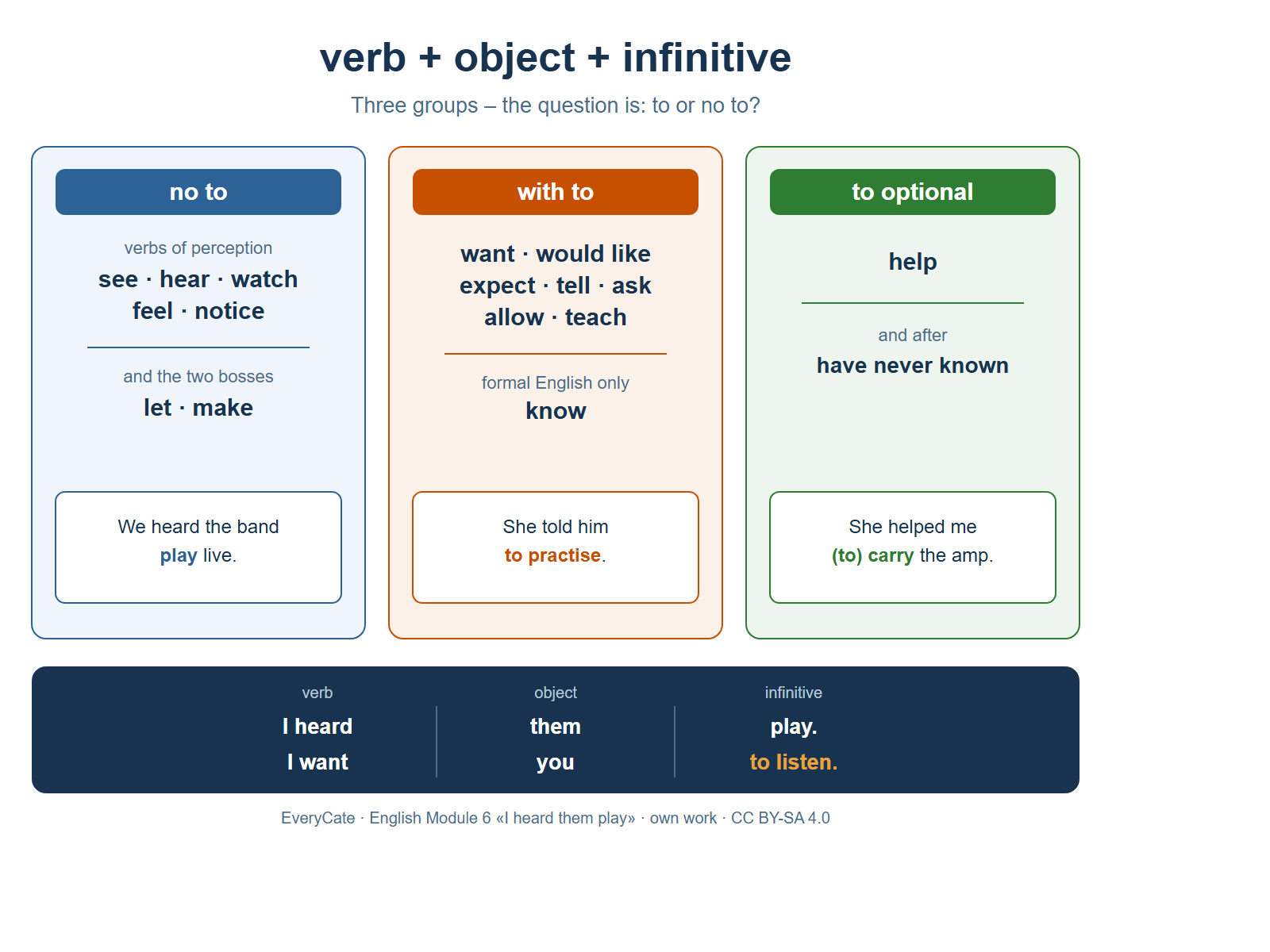
Group 1 – infinitive WITHOUT to (bare infinitive):
Verbs of perception – see, hear, watch, feel, notice:
- I saw him cross the street.
- We heard the band play live.
And the two bosses let and make:
- Let him finish the song.
- The producer made them record it again.
Group 2 – infinitive WITH to:
want, would like, expect, tell, ask, allow, teach:
- I want you to listen.
- She told him to practise.
Also know in formal English: «I know him to be reliable.»
Group 3 – special cases, to is optional:
- help: She helped me (to) carry the amp.
- after have never known: I've never known him (to) lose his temper.
The chart below puts the three groups side by side – keep it open while you practise.
The pattern at a glance
Hear them play – or hear them playing?
One small extra for Group 1: after verbs of perception, English can also use the -ing form – with a small difference in meaning.
- I heard them play. → the whole thing, from the first note to the last.
- I heard them playing. → you caught them in the middle of it.
That is all you need here – in this module, we practise the infinitive.
How to translate it – auf Deutsch
Jetzt wird es spannend – denn wörtlich übersetzen funktioniert hier NICHT.
Der Standard: ein dass-Satz.
- «I want you to listen.» = «Ich will, dass du zuhörst.» – und nicht: «Ich will dich zuhören.»
Die Ausnahme: Wahrnehmungsverben. Bei sehen und hören kann das Deutsche die Konstruktion behalten:
- «I heard them play.» = «Ich hörte sie spielen.» (auch möglich: «Ich hörte, wie sie spielten.»)
Und noch ein Überlebender: lassen.
- «Let him go.» = «Lass ihn gehen.»
Im Deutschen überlebt die Konstruktion Akkusativ + Infinitiv also nur bei sehen, hören, lassen (und vereinzelt bei fühlen/spüren). Überall sonst brauchst du einen Nebensatz – meist mit dass – oder einen Infinitiv mit zu («Sie erlaubte mir mitzukommen»).
Where does this come from?
Aus dem Lateinunterricht kennst du vielleicht den AcI (accusativus cum infinitivo): «Video eum venire.» = «Ich sehe ihn kommen.» / «Ich sehe, dass er kommt.» Im Latein stand er nach Verben des Sagens, Meinens und Wahrnehmens.
Auch die germanischen Sprachen kennen diese Konstruktion seit jeher – bei see und hear ist sie altes Erbe, bei Verben wie know oder expect halfen lateinische Vorbilder nach. Das Deutsche dagegen hat sie fast ganz durch den dass-Satz ersetzt.
Exercise 1: to or no to?
Frage 1 von 6Choose the correct form for each gap. Think: which group does the first verb belong to?
Our music teacher made us ___ the scales every morning.
Exercise 2: Build the sentences
Drag the building blocks – object + infinitive – into the gaps (on a phone: tap the block first, then the gap). Careful: three blocks in the list fit nowhere.
Tippe zuerst ein Wort an und dann die Lücke, in die es gehört. Antippen einer gefüllten Lücke legt das Wort zurück.
Everyone in the hall heard the high note. The band's manager expects ready backstage at six o'clock sharp. Let the last verse – it is nearly midnight! Our conductor made the guitars to the piano before the show. She asked the tickets online. I noticed the hall through the back door. The music school allowed in the adults' choir, even though I am only fourteen.
Exercise 3: Type the form
Complete each sentence with the verb in brackets – with or without to. Type only the infinitive part.
The teacher made us (repeat) the chorus. I would like you (meet) our new bass player. Nobody saw the drummer (leave) the backstage area. The conductor told the choir (stand) up. Please let the intro (play) to the end. We expect the concert (start) at eight.
Exercise 4: Match the translations
Eight English sentences, eight German translations. The words look similar on purpose – only the RULE tells you which translation is right: dass-clause, or the old pattern with sehen/hören/lassen?
Tippe ein Element links und eines rechts an, um ein Paar zu bilden – mit welcher Seite du beginnst, ist egal. Nochmaliges Antippen wählt ab; Antippen eines verbundenen Elements löst das Paar wieder.
Exercise 5: Find the correct sentence
Frage 1 von 4One of the two sentences is correct, the other one has a typical mistake. Choose the correct one – and read the explanation to see what the mistake was.
Which sentence is correct?
Final quiz: the pattern, the little to, and the dass-Satz
Frage 1 von 6Six questions: five from this module – plus one look back at an earlier module of the unit.
After which verbs does the infinitive stand WITHOUT to?